A homeowner with a burst pipe is not loyal to you. They are loyal to whoever picks up. They dial three contractors off a Google search, and the one who answers and can help soonest gets the job. Price comes up later, if it comes up at all. That is not a theory. It is what the data on lead response has shown for over a decade, across every study that has measured it.
Below is the research that matters for the trades, what each number means, and how to tell whether your own shop is winning or losing this race.
78% of customers buy from the first responder
The most-cited number in lead response is also the most uncomfortable: roughly 78% of customers buy from the business that responds to their inquiry first. The figure comes from a Lead Connect buyer survey, widely popularized by Vendasta, and it reorders how most owners think about competition. You are not mainly competing on being cheaper or better reviewed. You are competing on being first.
For a homeowner with an urgent problem, "first" is a proxy for "available," and "available" is a proxy for "competent enough to solve this now." Speed reads as reliability. The contractor who calls back two hours later is not slightly behind; they are usually out of the running.
The five-minute rule: respond now or qualify nothing
Speed does not decay gently. It falls off a cliff. The Lead Response Management Study, led by Dr. James Oldroyd, analyzed thousands of inbound leads and found that contacting a lead within five minutes makes you about 100x more likely to reach them and 21x more likely to qualify the lead than waiting just 30 minutes.
Read that gap again. The difference between five minutes and half an hour is not a few percentage points. It is twenty-one times. A lead that is gold at minute four is close to worthless by minute thirty-one, because by then the homeowner has reached the next name on their list.
| Response window | What the research shows |
|---|---|
| Within 1 min | Highest contact and conversion rates recorded; some studies report large conversion lifts versus any delay. |
| Within 5 min | ~100x more likely to make contact and ~21x more likely to qualify the lead vs. 30 minutes (Lead Response Management Study). |
| Within 1 hr | ~7x more likely to qualify the lead than responding an hour later; 60x more likely than waiting 24+ hours (Harvard Business Review). |
| 42 hrs (avg) | The average first response time measured across businesses, with 23% never responding at all (Harvard Business Review). |
The one-hour cliff, and why most businesses fall off it
Harvard Business Review's study "The Short Life of Online Sales Leads" put hard numbers on the cost of waiting. Companies that responded within an hour were nearly seven times more likely to qualify a lead than those that waited an hour longer, and sixty times more likely than those that waited a day or more.
Then came the part that should worry every owner: the average company took about 42 hours to respond, and 23% never responded at all. The bar is on the floor. Most of your competitors are slow. That is the opportunity hiding inside these statistics, and it is why a small operator who answers fast can beat a bigger shop that does not.
Why this hits home services harder
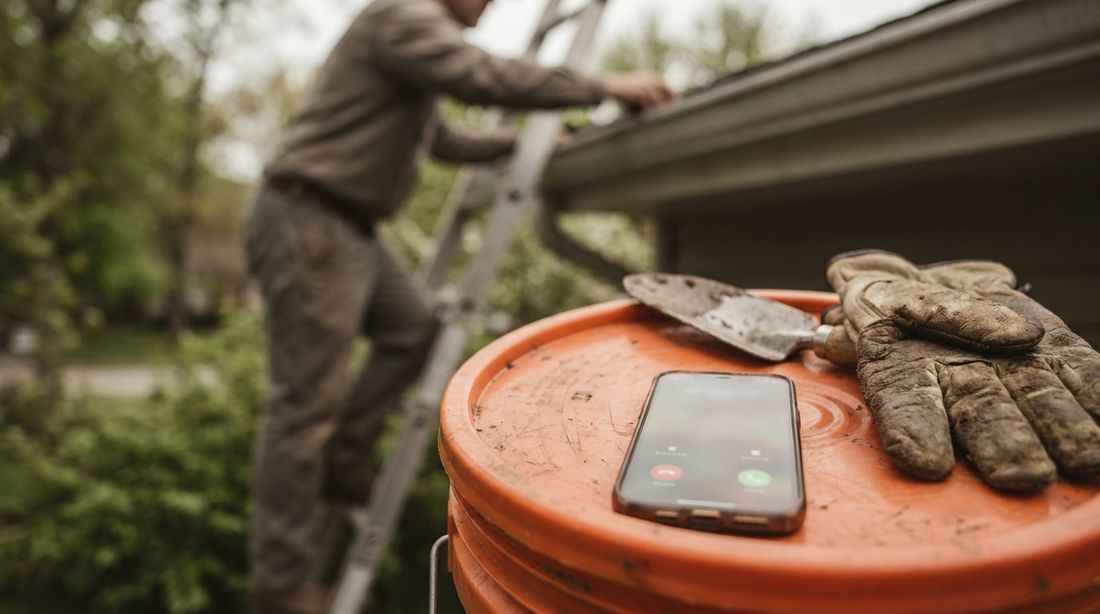
General sales statistics understate the problem for contractors, because a tradesperson cannot answer the phone from inside a crawlspace or off a roof. The result shows up in the call data. Home-service businesses commonly miss around a quarter of inbound calls, and the miss rate climbs after hours and on weekends, exactly when homeowners discover the leak, the outage, or the broken unit.
The lost call does not come back, either. Most callers who do not reach a live person will not leave a voicemail. They hang up and dial the next contractor on the list. A missed call in the trades is rarely a message waiting for you later; it is a booked job for someone else, already gone.
- ~1 in 4 inbound calls to home-service businesses go unanswered, with higher rates after hours.
- The majority of callers who hit voicemail will not leave a message, they call a competitor.
- A large share of service calls arrive outside business hours, when no one is at the desk.
Stack those on top of the five-minute rule and the picture is stark. The window to win a home-services lead is short, the calls arrive when you are least able to answer, and the homeowner has three other numbers ready to dial.
What the numbers add up to
Pulled together, the research says one thing: in home services, response speed decides the outcome before price, reviews, or workmanship ever enter the conversation. The data is consistent across fifteen years and every study that has measured it. Speed wins.
The honest next question is not whether this is true. It is whether your shop is fast. Most owners overestimate, because they remember the calls they caught and forget the ones they missed. Two numbers tell the truth: the percentage of inbound calls you answer live, and how long a missed call sits before anyone responds. Those two figures explain most of your booked-job rate.
If you do not know your numbers, that is the place to start. The Growth Score measures your answer rate, response speed, and booking conversion, then shows you where you are losing the speed game and what it is costing you each month. It takes about three minutes. For the strategy side of the same problem, the Lead Response Speed pillar covers the tactics that move those numbers.
Sources
- Oldroyd, J. B., McElheran, K., & Elkington, D. "The Short Life of Online Sales Leads." Harvard Business Review, March 2011. hbr.org/2011/03/the-short-life-of-online-sales-leads
- Lead Response Management Study (Dr. James Oldroyd): five-minute response findings, widely cited in lead-response research summaries.
- Lead Connect buyer survey, popularized by Vendasta: "78% of customers buy from the first responder." vendasta.com/blog/lead-response-time
- 2026 home-services phone and missed-call data, compiled from industry analyses of contractor call handling. Figures are reported ranges; verify against your own call records.
Statistics compiled June 2026. Percentages are drawn from the cited studies and industry data; treat them as directional benchmarks, not guarantees.

Jeffrey R. Rose is a systems operator and growth strategist with 20+ years building and scaling businesses across technology, consumer products, and food service. A software engineer and entrepreneur, he has founded, grown, and exited multiple companies, including a global health and supplement brand. At Kinjo Pro he leads systems architecture and AI implementation.
Frequently Asked Questions
Speed to lead is the time between a prospect reaching out (a call, form, or text) and your first real response. In home services it is the strongest predictor of who books the job, because roughly 78% of customers hire the first company to respond.
Within five minutes. The Lead Response Management Study found that responding inside five minutes makes you about 21 times more likely to qualify a lead than waiting 30 minutes. After the first hour, the odds collapse.
About 78%. Research popularized by Vendasta (originally from a Lead Connect survey) found that 78% of customers buy from the business that responds first, ahead of price and reviews.
Far too long. Harvard Business Review's study of online sales leads found the average first response took about 42 hours, and 23% of companies never responded at all.