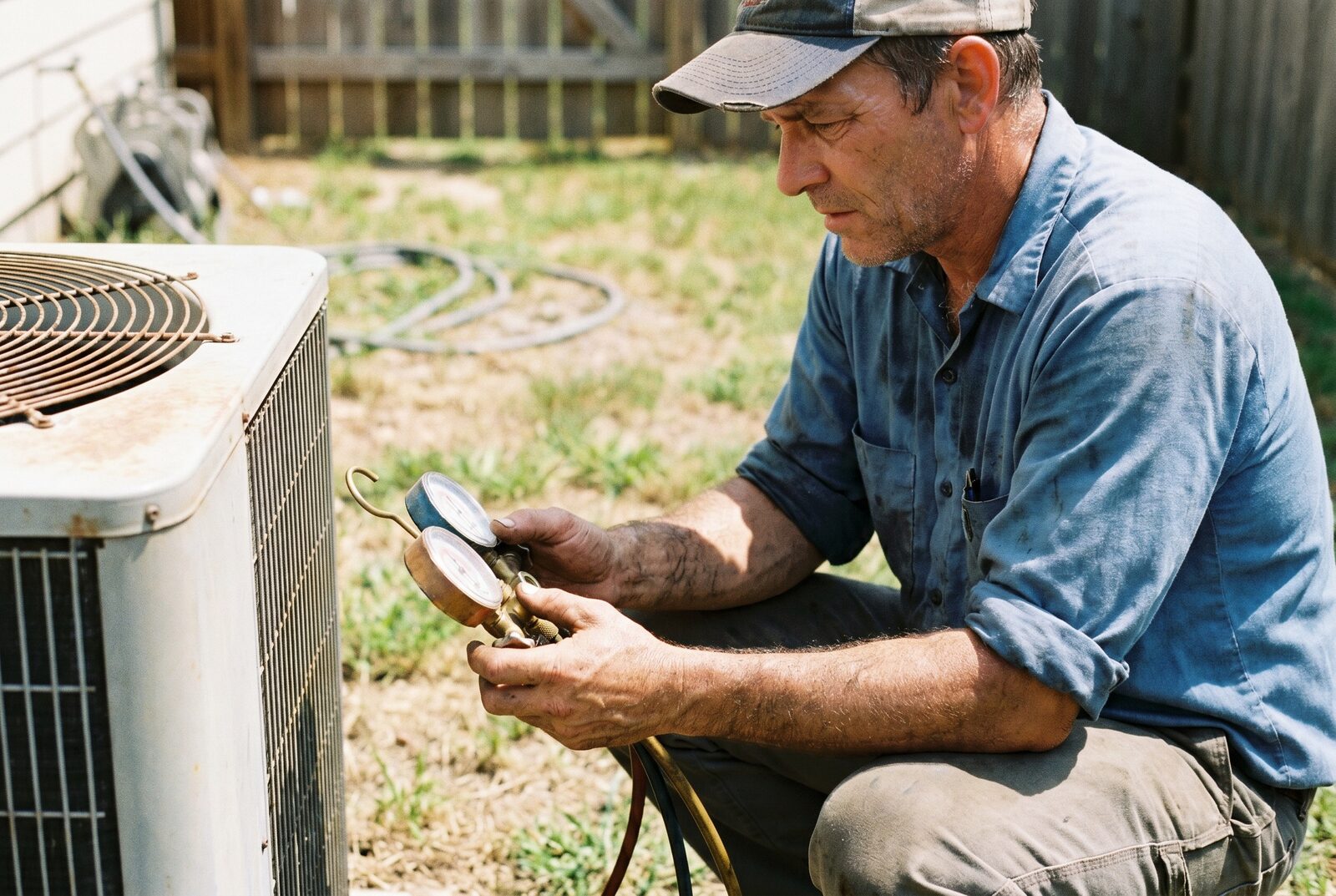
He's three floors up, knees on a rooftop unit that's been down since Tuesday, gauge manifold in one hand. It's the kind of afternoon when the temperature and the call volume climb together. Somewhere below him, on a phone he can't reach from a roof, the line is already ringing for the third time this hour.
This is what July does to HVAC contractors every year. Demand doesn't rise gradually. It spikes on the first genuinely brutal day of summer, at the exact moment every tech in the company is elbow-deep in a job that also can't wait.
A rooftop call is still a call
Nobody built the front office for this. A homeowner with no air conditioning in a heat wave is not a patient caller. She will not leave one voicemail and sit tight for a callback. She will hang up and dial the next name on the list, and by the time anyone in the office notices the missed call, that job belongs to someone else.
Meanwhile the one person who could actually pick up is thirty feet in the air with both hands on a manifold gauge. Answering isn't really an option, even for a tech who wants to.
Why hiring for the summer spike doesn't work
The obvious fix is to bring on extra help for the busy months, and it runs straight into its own math. Staff for the worst morning of July and that headcount sits idle every slow week in October. Staff for a normal week and the first heat wave buries the desk anyway. There's no headcount that matches a demand curve this uneven.
The problem was never really how many people answer the phone. It's what happens in the gap between the ring and the moment someone is actually free to pick it up.
What changes when the phone answers itself
Kinjo picks up every call the moment it comes in, whether it's the first one of the morning or the fourth one stacked behind a tech who's still on a roof. For HVAC specifically, it does three things:
Triage urgency. "No cooling with an infant in the house" gets treated differently than "thinking about a system upgrade next spring." The tech rolling up already knows what he's walking into.
Capture the equipment basics. System type, age, symptom, the same questions a good service writer would ask, so nobody is guessing on the drive over.
Book against real openings. Same-day and next-day slots fill automatically instead of waiting for whoever remembers to check the schedule between jobs.
For the tech on that rooftop, none of it requires putting the gauges down. Kinjo already texted the next customer an arrival window before he finished bleeding the line. The call waiting behind this job doesn't sit in a voicemail box until 6pm.
The math on the call nobody answered
A missed call during a heat wave rarely just disappears. It becomes a one-star review from someone who says they called three times and never heard back. It becomes a job on a competitor's schedule instead of yours. And it spends the same marketing dollars that got the phone to ring in the first place, on a lead that never turned into a customer.

Jaymo Barnard is a brand strategist and growth architect with 25+ years building scalable marketing systems across wellness, media, consumer products, and education. As founder and CEO of Mandala Growth Partners, he has led initiatives behind major acquisitions, national brand launches, and multi-million-dollar lead-generation systems. At Kinjo Pro he leads brand strategy and growth architecture.
Frequently Asked Questions
It asks the questions a good dispatcher would ask: whether there's any cooling at all, how old the system is, whether anyone in the house is medically vulnerable to heat. Calls that read as urgent get flagged for a same-day slot instead of sitting in a queue.
Most contractors don't. Kinjo handles unlimited simultaneous calls, so the busiest morning of the year doesn't need a different headcount than a slow Tuesday in October.
It doesn't sit in a voicemail box. The caller gets a real next-available slot or a text confirming when they'll hear back, so the lead stays warm instead of going cold before anyone follows up.